About the Plan
Atascadero is ready to advance the city towards a safe, healthy, sustainable, and prosperous future. The General Plan is the City of Atascadero’s overarching policy document and will establish direction and programs that support housing for all, improve neighborhood quality and connectivity, foster economic development, and reinforce environmental protection citywide.
Atascadero has a history of making and implementing great plans. As the City approaches 2025, residents, business owners, and City leaders can reflect on what has been achieved as envisioned in Atascadero’s previous General Plan: new housing types, public and private reinvestments in downtown, development focused within the Urban Services Line, continued protection of hillsides and habitats, and a citywide Bikeway Master Plan. Planning for the next two to three decades will build upon these successes while accounting for the rapid technological and societal changes affecting how people work, shop, recreate, and move around. The COVID-19 pandemic caused many shifts likely to be permanent—particularly work-at-home jobs, online shopping, and home food delivery. These conditions, as well as the impacts of climate change, will be critical topics for discussion with the community as we develop Atascadero’s General Plan 2045.
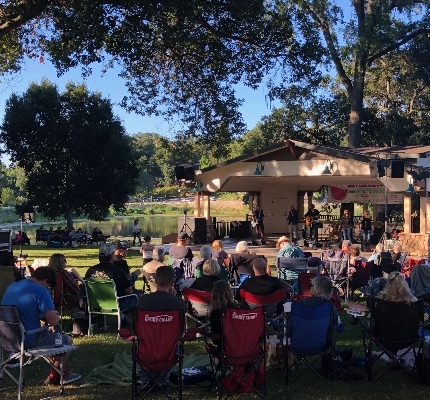
Concert series at Atascadero Lake

Famers’ Market in Atascadero Sunken Gardens
What is a General Plan?
A General Plan is a comprehensive policy document that provides the general framework for all land use and zoning decisions within a community. It establishes a community’s long-term vision for the future and contains goals and policies that will shape future housing, support economic development and job growth, foster healthy and resilient neighborhoods, protect and manage natural resources, ensure community safety, and promote social and economic equity.
The City of Atascadero’s current General Plan was last comprehensively updated in 2002 (General Plan 2025). The State of California recommends that cities update their General Plans approximately every 15 to 20 years. The State also provides guidance on the required and suggested content for General Plans. However, each community is encouraged to identify policy and program solutions in their General Plan that address local community needs and desires.
What is the Purpose and Role of a General Plan?
At its core, a General Plan is a long-term plan for development of the community. The State requires that each city or county General Plan address a minimum set of topics, is internally consistent, and is legally enforceable by virtue of numerous consistency requirements. At the local government level, the General Plan has been described as a “blueprint” or “constitution” for land use and development decisions.
Current General Plan requirements date to the mid-1950s. In the late 1960s and early 1970s, the required scope expanded from two to nine elements, then reduced to seven in 1984. In 2017, an eight Environmental Justice Element was added. The State legislature passed the first consistency requirements in 1970 and 1971.
Over the years, the State Legislature has linked many new mandates directly and indirectly to the General Plan. The Governor’s Office of Planning and Research (OPR) regularly updates General Plan Guidelines to help communities understand the content requirements.
Why is the General Plan Imporant
The General Plan frames the community vision for how Atascadero should grow and change over the coming years and decades. It is important for the document to reflect community priorities and values while shaping this future. As the City's overarching policy document, every land use, mobility, infrastructure, program, and environmental decisions made by the City Council, Planning Commission, other commissions, and City staff needs to be consistent with the vision, goals, policies, programs, and actions included in the General Plan.
What are Mandatory General Plan Topics?
The State requires Atascadero to address seven mandatory “elements” or topical chapters. These topics can be addressed as stand-alone chapters or integrated into other parts of the General Plan (e.g., the State allows flexibility in how the General Plan is organized, as long as the required topics are addressed). The City can also address additional topics it finds imporant, including economic development, infrastructure, and community health.
Land Use
Designates the type, intensity, and general distribution of uses of land for housing, business, industry, open space, education, public buildings and grounds, waste disposal facilities, and other categories of public and private uses
Circulation
Correlates with the land use element and identifies the general location and extent
of existing and proposed major roads, transportation routes, terminals, and
other local public utilities and facilities.
Housing
Assesses current and projected housing needs for all economic segments of the community and embodies policies and programs for providing adequate housing. The City’s current Housing Element was adopted in 2020 and is valid until 2028. It will not be a part of this current update process but can be used to inform and supplement this activity.
Open Space
Details plans and measures for the long–range preservation and conservation of open–space lands, including open space for the preservation of natural resources, the managed production of resources, agriculture, outdoor recreation, and public health and safety.
Conservation
Addresses the conservation, development, and use of natural resources, including water, forests, soils, rivers, and mineral deposits
Safety
Establishes policies and programs to protect the community from risks associated with seismic, geologic, flood,
and wildfire hazards, as well as from other concerns such as drought.
Noise
Identifies and appraises noise problems within the community and forms the basis for land use distribution determinations.
Why is the General Plan Being Updated?
The City of Atascadero’s current General Plan was last comprehensively updated in 2002. In this rapidly evolving world, an update creates the opportunity to address current challenges and emerging trends. As the City’s overarching policy document, all decisions made by the City Council, Planning Commission, other commissions, and City staff need to be consistent with the vision, goals, policies, programs, and actions included in the General Plan. Over the next year or two, staff will focus work efforts on a comprehensive update to the General Plan, looking forward toward year 2045.
It is important that the General Plan reflects community priorities and values. Using an intensive, inclusive, and creative community engagement process, the new General Plan will focus on achieving well-defined guiding principles for a wide range of topics. This General Plan program represents an opportunity for residents and the business community to share their ideas about planning Atascadero’s future, both in terms of near-term actions and a long-term vision.
The General Plan Update process is an opportunity to evaluate long-term city growth, resources, public services and facilities, and a host of other topics essential to our quality of life. This includes policy about where housing can be built, where new commercial businesses are needed, how the road network can better accommodate cyclists and pedestrians, how parks can be improved, and how public safety is addressed in our daily activities, including exposure of people to noise and air pollutants.
What is the Project's Schedule?
The General Plan Update provides a tremendous opportunity for the community, City staff, Commissions, and Council to discuss and refine the vision for what the community can and should become over the coming years and decades. The overall process for updating a General Plan includes a combination of analysis, reports and designs that are reviewed and refined by the community during different phases of the project – with decisions for each phase informing the next phase.
The Project Schedule shows how the various phases of the project will be completed over the next few years. This approach includes meetings with the City Council at the beginning (to help frame the process) and end (to review community feedback and provide direction) of each project phase.